
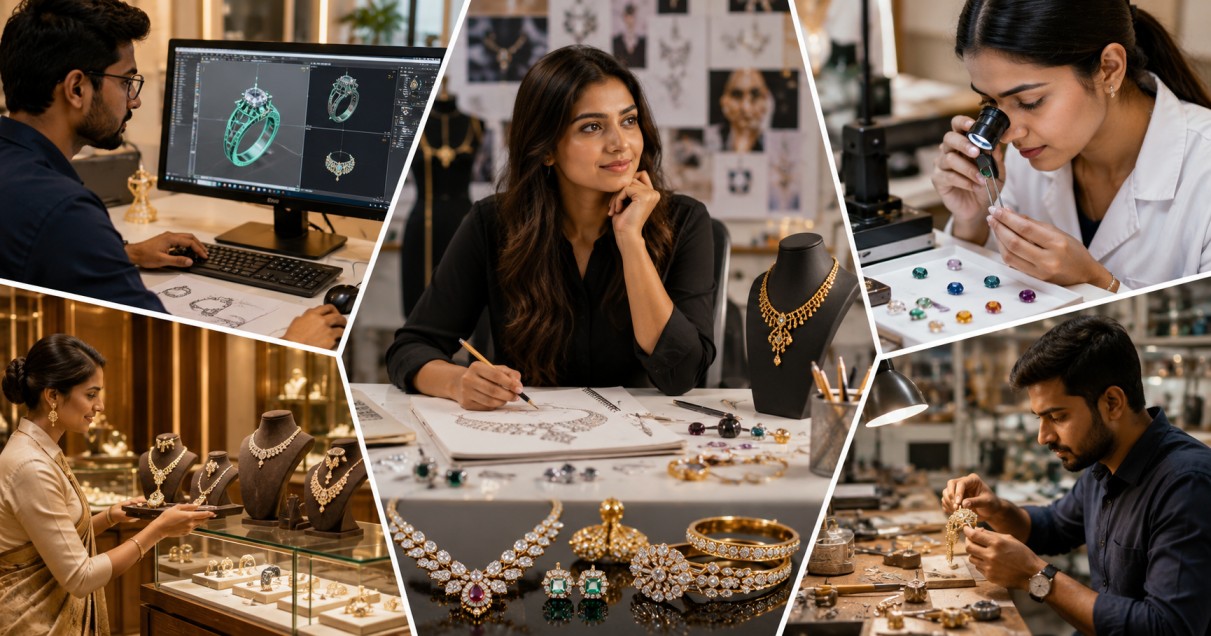
Top Career Options After a Jewellery Design Course in India
Most students who enrol in a jewellery design course assume their only career option is to become a jewellery designer. However, the reality is far more exciting. A jewellery design course equips you with a diverse set of skills - creativity, technical knowledge, industry understanding, and business awareness - that open doors across multiple career paths. From CAD jewellery design to entrepreneurship, from retail to education, the gems and jewellery industry offers a wide variety of roles for trained professionals.
This guide explores the top career options available to you after completing a jewellery design course in India, along with honest salary expectations and practical guidance on choosing the right program.
Why a Jewellery Design Course Opens More Doors Than You Think
India's gems and jewellery industry is one of the most powerful in the world. It contributes nearly 7 to 8 percent of India's total merchandise exports and employs over 5 million people across design, manufacturing, retail, and trade functions.
The industry is also evolving rapidly. Consumer preferences are shifting towards certified, design-forward, and ethically produced jewellery. Brands are investing heavily in talent. Technology like CAD and 3D printing is transforming how jewellery is designed and manufactured. Therefore, the demand for formally trained jewellery professionals has never been stronger.
A jewellery design course does not just teach you how to sketch a ring. It builds a complete professional skill set that employers across design studios, retail brands, export houses, and manufacturing units actively seek. Also, it gives you the foundation to build your own successful business if that is your goal.
Career Option 1 - Jewellery Designer
The most direct career path after a jewellery design course is, naturally, becoming a jewellery designer. However, this role is far broader and more dynamic than most people expect.
What Does a Jewellery Designer Actually Do?
A jewellery designer creates original jewellery concepts for brands, manufacturers, retailers, and private clients. They work across the entire design process - from initial concept and sketching to final production supervision.
Jewellery designers work in design studios, manufacturing units, retail brands, and export companies. Some work as freelancers, taking on briefs from multiple clients simultaneously. Others work in-house with a single brand, building and maintaining a consistent design identity.
Top jewellery brands in India - including Tanishq, Malabar Gold, PC Jeweller, and Kalyan Jewellers - regularly hire trained jewellery designers for their design and product development teams.
Jewellery Design Drawing - The Foundation of Every Great Design
Before any jewellery piece is made, it must be drawn. Jewellery design drawing is the skill of translating a creative idea into a detailed technical sketch that communicates proportions, stone settings, metal weight, and surface finish to a manufacturer.
A strong jewellery design course teaches you to draw from multiple angles, use correct proportions, indicate stone types and sizes, and apply rendering techniques to make your designs look realistic and professional.
Good drawing skills also make you a stronger CAD designer because you already understand how a three-dimensional piece of jewellery should look before you model it digitally.
Career Option 2 - CAD Jewellery Designer
CAD jewellery design is one of the fastest-growing and most in-demand specialisations in the jewellery industry today. If you complete a CAD jewellery design course alongside your foundational design training, your employability increases dramatically.
What is CAD Jewellery Design?
CAD stands for Computer-Aided Design. In jewellery, CAD software allows designers to create precise, three-dimensional digital models of jewellery pieces on a computer screen. These digital models can be rotated, viewed from any angle, edited in seconds, and sent directly to a 3D printer to produce a wax or resin model for casting.
The most widely used CAD software in the jewellery industry includes Rhinoceros 3D (Rhino), Matrix, ZBrush, and JewelCAD. Each has its strengths and is used at different stages of the design and production process.
Why CAD Skills Are in High Demand Right Now
Traditional jewellery design was entirely hand-drawn and handmade. While handcraftsmanship remains deeply valued, CAD technology has transformed the speed, precision, and scale at which jewellery can be designed and produced.
A design that once took weeks to hand-carve in wax can now be modelled in CAD in a few hours and printed overnight. This speed gives brands a massive competitive advantage. Therefore, companies actively seek designers who are fluent in both traditional design principles and modern CAD tools.
Also, CAD design allows for near-perfect accuracy in stone setting, prong placement, and metal weight calculation - all critical factors in commercial jewellery production.
CAD Jewellery Design Course - What You Learn
A dedicated CAD jewellery design course teaches you to use professional software to model rings, pendants, earrings, bangles, and complex multi-stone jewellery pieces. You learn to create clean, manufacturable designs that meet industry production standards.
Good CAD courses also include training in 3D rendering - applying realistic materials, lighting, and backgrounds to your digital models to create photorealistic images for presentations, catalogues, and client approvals.
CAD jewellery design course fees in India typically range from ₹25,000 to ₹1,00,000, depending on the software covered, duration, and institute quality.
Explore ISGJ's Graduate in Jewellery Design & Technology
Career Option 3 - Handmade Jewellery Designer and Artisan
Not every jewellery professional works on a computer screen. Handmade jewellery design is a deeply respected craft that has gained extraordinary momentum in recent years, both in India and globally.
The Growing Global Market for Handmade Jewellery
Consumers worldwide are increasingly drawn to handmade, artisanal jewellery. They want pieces with a story, a unique character, and human craftsmanship that no machine can replicate. The global handmade jewellery market is growing steadily, driven by platforms like Etsy, Instagram, and luxury boutiques that celebrate artisan work.
In India, the tradition of handmade jewellery is centuries old. Regions like Rajasthan, Gujarat, and Tamil Nadu have distinct handmade jewellery traditions that are admired globally. A trained handmade jewellery designer can tap into this rich heritage and build a distinctive brand around it.
How Handmade Jewellery Design Differs from CAD Design
Handmade jewellery design involves working directly with metals - cutting, filing, soldering, forming, and setting stones by hand. It requires physical skill, patience, and a deep understanding of metal behaviour and stone-setting techniques.
CAD design, on the other hand, is a digital process. However, the two are not mutually exclusive. Many of the best jewellery designers today are fluent in both handmade techniques and CAD, giving them the flexibility to work across design styles and production methods.
A quality jewellery design course will introduce you to both approaches so you can decide which direction suits your strengths and career goals.
Career Option 4 - Jewellery Merchandiser
Jewellery merchandising is a career that sits at the intersection of design, retail, and business. It is also one of the most underrated career options that students discover after completing a jewellery design course.
What is Jewellery Merchandising?
A jewellery merchandiser is responsible for managing a brand's product range - deciding which designs to produce, in what quantities, at what price points, and for which markets. They analyse consumer trends, monitor competitor products, plan collections, and work closely with designers and buyers.
In large jewellery retail chains, a merchandiser is a critical link between the creative team and the commercial team. Their decisions directly affect how well products sell and how profitable the business is.
Why Brands Need Trained Merchandisers
India's organised jewellery retail sector is growing fast. National chains are expanding to new cities and towns. Each store needs carefully curated product ranges that match local tastes, price sensitivities, and seasonal demand patterns.
A trained merchandiser who understands jewellery design, gemstones, and consumer psychology is therefore extremely valuable to any growing jewellery brand. This is a role that pays well and offers strong career progression into senior buying, product management, and retail leadership positions.
Career Option 5 - Jewellery Retail Professional
The jewellery retail industry in India is enormous. From small independent jewellers to large national chains and global luxury brands, retail is where a huge proportion of jewellery industry jobs exist.
Roles Available in Jewellery Retail
Within jewellery retail, trained professionals can work as sales consultants, store managers, product trainers, visual merchandisers, brand executives, and customer experience specialists. Each role benefits directly from a formal jewellery education background.
A sales consultant who understands diamond grading, gemstone quality, and design principles can guide customers with genuine expertise. This builds trust, closes more sales, and creates loyal customers who return again and again.
How a Jewellery Design Course Gives You a Retail Edge
Most retail employees learn about jewellery on the job, picking up knowledge slowly and inconsistently. A candidate who arrives with formal jewellery design course training already understands design terminology, material quality, gemstone characteristics, and industry standards.
This makes them immediately more effective in customer-facing roles and faster to progress into senior positions. Therefore, many top jewellery retailers actively prefer to hire candidates with formal jewellery education backgrounds over those without.
Career Option 6 - Jewellery Entrepreneur and Business Owner
One of the most exciting outcomes of a jewellery design course is the confidence and knowledge it gives you to start your own business. India's jewellery market offers genuine entrepreneurial opportunities at multiple levels.
Starting Your Own Jewellery Brand
Many ISGJ alumni have launched their own successful jewellery brands after completing their education. Harshit Bansal of Renani Jewels - a Guinness World Record holder - and Roshni Banthia of Tatsam Jewels are just two examples of former students who turned their education into thriving businesses.
Starting a jewellery brand today does not require a large physical store. Many successful jewellery entrepreneurs begin by building a strong Instagram presence, working with a small manufacturer, and selling through their own website or platforms like Etsy and Amazon Handmade.
Selling Handmade Jewellery Online - A Real Business Opportunity
The handmade jewellery segment is particularly well-suited to an online business model. Consumers appreciate the story behind handmade pieces, and social media platforms allow designers to connect directly with buyers without needing a traditional retail presence.
A jewellery design course gives you the design skills, product knowledge, and industry understanding to create a compelling brand. Combine that with basic digital marketing knowledge, and you have everything you need to launch a viable jewellery business from scratch.
Career Option 7 - Jewellery Educator and Trainer
After building professional experience in the jewellery industry, many trained designers and gemologists transition into education - becoming trainers, faculty members, or curriculum developers at jewellery institutes and corporate training programmes.
Jewellery education is a growing field in India. As more institutes, brands, and manufacturer associations invest in staff training and professional development, the need for qualified educators with real industry experience is increasing steadily.
Also, many experienced jewellery professionals run their own private workshops and masterclasses, teaching specific skills like handmade jewellery making, CAD design, or stone setting to students and hobbyists. This can be a highly fulfilling and financially rewarding path for those who enjoy sharing knowledge.
Career Option 8 - Jewellery Export and Trading Professional
India is one of the world's largest jewellery exporters. Surat dominates global diamond processing. Mumbai is home to major diamond trading and export companies. Therefore, the jewellery export sector creates significant employment for professionals who combine design knowledge with trade expertise.
Roles in jewellery export include export executive, quality control inspector, buyer liaison, product sourcing specialist, and trade documentation coordinator. Professionals with a jewellery design course background are valuable in these roles because they understand the product deeply - its design, quality parameters, and value drivers.
Export professionals also work closely with international buyers from the USA, Europe, the Middle East, and Southeast Asia. Therefore, communication skills and cultural awareness are important additional assets in this career path.
Career Option 9 - 3D Rendering and Visualisation Artist
3D rendering is a specialised technical skill that has become indispensable in modern jewellery design. A 3D rendering artist uses software to create photorealistic digital images of jewellery pieces - often before a single piece of metal has been touched.
These rendered images are used in brand catalogues, e-commerce websites, client presentations, and advertising campaigns. High-quality renders allow brands to present hundreds of designs to buyers digitally, saving enormous time and production costs.
As India's jewellery e-commerce sector grows, the demand for skilled 3D rendering artists is increasing rapidly. Professionals who combine strong CAD modelling skills with advanced rendering expertise can build excellent careers - either in-house with a jewellery brand or as freelancers serving multiple clients.
Career Option 10 - Jewellery Photographer and Content Creator
In the age of Instagram and online jewellery retail, visual content is everything. A jewellery photograph can make the difference between a sale and a scroll past. Therefore, specialised jewellery photography has emerged as a genuine career niche.
Jewellery photographers understand how light interacts with metal and gemstones. They know how to position a piece to capture its best angles, bring out its sparkle, and communicate its craftsmanship to the viewer. This requires both technical photography skills and a deep appreciation of jewellery design.
Also, many jewellery brands now employ dedicated content creators who manage their social media presence, produce video content, write product descriptions, and build the brand's visual identity. A background in jewellery design gives content creators a genuine advantage because they understand what makes a design special and how to communicate that authentically.
What Salary Can You Expect After a Jewellery Design Course?
Salary expectations after a jewellery design course depend on the role, location, employer size, and level of specialisation. Here is a realistic overview for professionals at different career stages:
A fresher with a jewellery design course qualification can typically expect a starting salary between ₹15,000 and ₹30,000 per month in a design, retail, or manufacturing role.
With two to three years of experience and specialisation in CAD jewellery design or merchandising, monthly earnings typically grow to ₹35,000 to ₹70,000.
Senior designers, design heads, export managers, and business development professionals with five or more years of experience often earn ₹80,000 to ₹1,50,000 per month or higher, particularly in larger organisations and export-focused companies.
Entrepreneurs and freelancers have uncapped earning potential. Many ISGJ alumni who have started their own jewellery brands or studios report annual revenues that far exceed what salaried roles would offer at the same career stage.
Choosing the Right Jewellery Design Course in India
With so many programs available across India, choosing the right jewellery design course is one of the most important decisions you will make. Not all courses are equal in quality, industry relevance, or career outcomes.
Jewellery Design Course Details - What to Look For
A strong jewellery design course should cover jewellery design, drawing and sketching, handmade jewellery techniques, CAD jewellery design using industry-standard software, gemstone and material knowledge, design history and trends, and production processes from concept to finished piece.
Also look for programs that include live industry projects, factory visits, guest lectures by working professionals, and a structured placement process. These elements distinguish a truly career-ready program from a purely academic one.
Jewellery Design Course Fees in India
Jewellery design course fees in India vary widely. A basic jewellery design course or short-term certificate program can cost between ₹20,000 and ₹80,000. A full graduate diploma program typically ranges from ₹1,00,000 to ₹3,00,000. Advanced programs, including CAD, business management, and gemology combined, can range from ₹3,00,000 upward.
When assessing fees, always evaluate the complete return on investment. Consider the placement record, the quality of faculty, the lab and studio infrastructure, and the strength of the institute's industry connections. A well-chosen education is an investment that pays for itself many times over across your career.
Jewellery Design Course in Surat - Why Location Matters
Surat processes over 90 percent of the world's diamonds and is one of India's most important jewellery manufacturing centres. Studying a jewellery design course in Surat means you are learning where the industry actually operates - surrounded by diamond traders, jewellery manufacturers, export professionals, and design studios.
This proximity gives students access to real industry exposure, internship opportunities, guest lectures from working professionals, and a professional network that simply does not exist in the same way elsewhere in India. For any student serious about building a career in gems and jewellery, Surat is the most strategically advantageous place to study.
Basic Jewellery Design Course vs Advanced Programs
A basic jewellery design course is the right starting point for complete beginners. It introduces fundamental design principles, materials, tools, and techniques in an accessible and structured way.
However, if you are serious about a long-term professional career, advancing to a graduate diploma, a specialised CAD jewellery design course, or a full degree program will significantly increase your career options, earning potential, and professional credibility.
ISGJ offers programs at every level - from basic certification to MBA - so students can start where their background and goals require and progress at their own pace.
Learn more: Short-Term Certificate Programs
Why ISGJ is the Best Place to Start Your Jewellery Design Career
ISGJ - International School of Gems and Jewellery - has been building careers in the gems and jewellery industry for over 25 years. With campuses in Surat, Ahmedabad, Hyderabad, Chennai, Sri Lanka, and Uzbekistan, ISGJ offers India's most comprehensive and industry-connected jewellery education ecosystem.
Here is what sets ISGJ apart from other jewellery design institutes in India:
Surat headquarters places every student at the centre of the global diamond and jewellery trade. No other institute offers this level of live industry proximity.
27+ specialised courses cover every aspect of the gems and jewellery industry - from basic jewellery design drawing to an MBA in Jewellery Business Management. You can build a complete professional education at a single institute.
Professional studios and labs equipped with industry-standard CAD workstations, gemological instruments, and handmade jewellery workshops give students real-world practical training from day one.
Expert faculty with active industry experience bring current market knowledge, real projects, and professional networks directly into the classroom.
Strong placement support connects graduates with India's leading jewellery brands, diamond trading companies, export houses, and retail chains.
Alumni success stories from entrepreneurs, designers, and industry leaders demonstrate the genuine career transformation that an ISGJ education delivers.
Frequently Asked Questions About Jewellery Design Careers
What can I do after completing a jewellery design course in India?
After a jewellery design course, you can work as a jewellery designer, CAD designer, merchandiser, retail professional, 3D rendering artist, or jewellery photographer. You can also start your own jewellery brand or pursue further education in gemology or business management.
Is a CAD jewellery design course necessary for a design career?
CAD skills are increasingly essential in the modern jewellery industry. While you can start a career with traditional design skills alone, adding a CAD jewellery design course to your qualifications significantly expands your career options and earning potential.
What is the difference between a basic jewellery design course and a graduate program?
A basic jewellery design course introduces fundamental design skills and is ideal for beginners. A graduate program offers a more comprehensive curriculum covering advanced design, CAD, gemology, business, and production - preparing students for a wider range of professional roles.
How long does a jewellery design course take in India?
Duration varies by program. Certificate and basic courses run from a few weeks to six months. Graduate and diploma programs typically take one to three years. MBA and Masters programs are usually one to two years in duration.
Is jewellery design a good career for women in India?
Absolutely. Jewellery design is one of the most rewarding career fields for women in India. Many of India's most successful jewellery designers and entrepreneurs are women. ISGJ has a strong record of empowering women students to build successful independent careers and businesses in the gems and jewellery industry.
Your Jewellery Design Career Starts Here
The gems and jewellery industry is waiting for talented, trained, and ambitious professionals. A jewellery design course is your entry point into a world of creative, commercial, and entrepreneurial opportunities that most people never even realise exist.
Whether you want to design the next iconic collection for a top Indian jewellery brand, build your own handmade jewellery label from your studio, or lead a global export business, your journey starts with the right education.
ISGJ has helped thousands of students make that journey successfully. You could be next.
Your future in jewellery design starts with a single step. Take it today.