
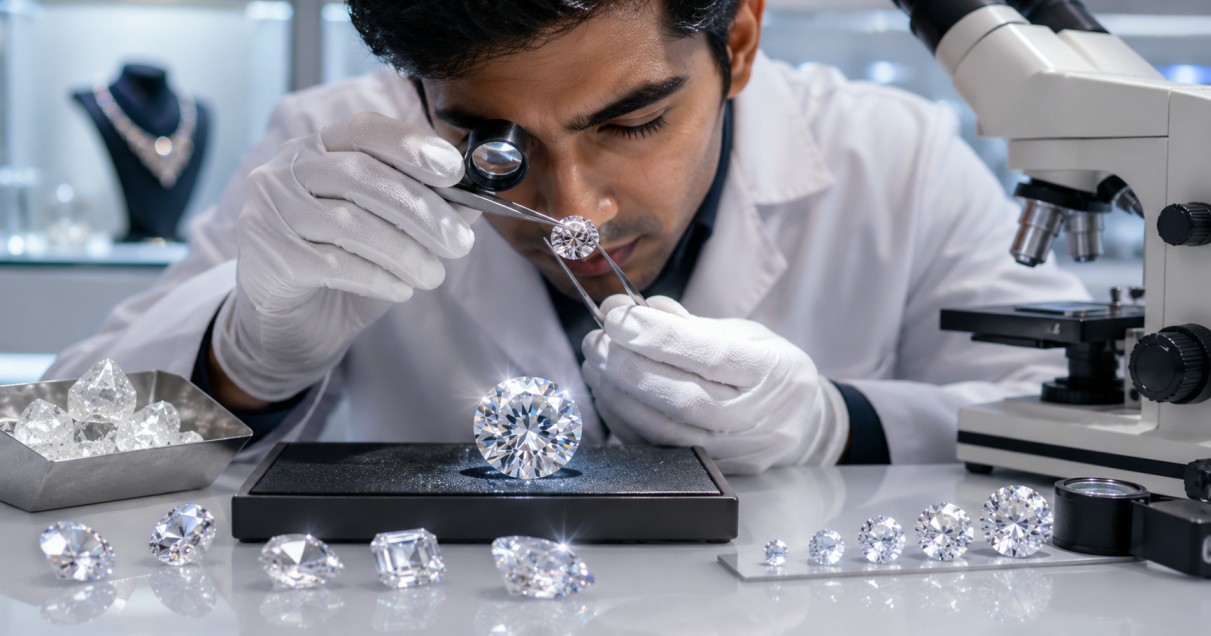
What are the 4Cs of Diamond Grading? Full Guide
Walk into any jewellery store and ask about a diamond. The first thing a trained professional will tell you about is diamond grading. It is the universal language of diamonds - a scientific framework that determines exactly how much a diamond is worth and why. Whether you are buying a diamond ring, evaluating a gemstone investment, or considering a career in the jewellery industry, understanding diamond grading is essential.
This guide walks you through the 4Cs of diamond grading in simple language, with real examples, practical insights, and information on how you can build a career around this fascinating science.
What is Diamond Grading and Why Does It Matter?
Diamond grading is the process of scientifically evaluating a diamond's quality using a standardised set of criteria. Every diamond in the world is unique. No two diamonds are exactly alike in structure, appearance, or value. Therefore, the industry needed a common language to describe and compare diamonds fairly and accurately.
That common language is the 4Cs framework - Cut, Colour, Clarity, and Carat weight.
Without diamond grading, buying or selling a diamond would be guesswork. A customer would have no way of knowing whether they are paying a fair price. A seller would have no objective way to justify their pricing. Grading removes the guesswork entirely and replaces it with science.
Also, diamond grading directly impacts the financial value of a stone. A difference of just one grade in colour or clarity can mean a price difference of thousands of rupees on a single stone. This makes grading one of the most critical skills in the entire gems and jewellery industry.
The History of the 4Cs Diamond Grading System
Who Created the 4Cs Framework?
The 4Cs system was developed by Robert M. Shipley, the founder of the Gemological Institute of America (GIA), in the 1940s. Before this system existed, diamond quality was described using vague and inconsistent terms. Different jewellers used different languages, which created massive confusion for buyers and sellers alike.
Shipley introduced the 4Cs as a simple, memorable, and universally applicable way to communicate diamond quality. His student, Richard T. Liddicoat, later developed the International Diamond Grading System at GIA, which became the global standard used by laboratories and jewellers worldwide.
How the 4Cs Became the Global Standard
GIA's grading system gained rapid acceptance across the industry because it was objective, consistent, and scientifically sound. Today, every major diamond grading laboratory in the world - including IGI, HRD, and AGS - bases its grading methodology on the foundations that GIA established.
When you see a diamond certificate from any reputable lab, the 4Cs are always at its core. This consistency gives consumers and traders worldwide a shared framework for trust.
The First C - Cut: The Most Important of All 4Cs
Of all four Cs, cut has the greatest impact on a diamond's beauty. Cut does not refer to the shape of the diamond - round, oval, princess, or pear. Instead, it refers to how well the diamond's facets have been crafted to interact with light.
A well-cut diamond reflects light brilliantly. It sparkles, flashes, and draws the eye. A poorly cut diamond, however, looks dull and lifeless - even if it has excellent colour and clarity grades.
Diamond Cut Grades Explained
GIA grades diamond cut on a five-point scale. From highest to lowest, the grades are: Excellent, Very Good, Good, Fair, and Poor.
An Excellent cut diamond allows light to enter, reflect internally, and exit back through the top of the stone in a dazzling display called brilliance. A Poor cut diamond allows light to leak out through the sides or bottom, making the stone appear dim and flat.
Think of it this way: imagine two windows of the same size. One is clean and perfectly positioned to catch the sunlight. The other is dirty and angled away from the light. The same amount of glass - but one is radiant, and the other is dark. Cut does exactly that to a diamond.
How Cut Affects a Diamond's Sparkle and Value
Cut quality affects three visual properties of a diamond: brilliance (white light reflection), fire (coloured light dispersion), and scintillation (sparkle when the diamond moves).
A diamond with an Excellent cut can appear larger and more brilliant than a diamond with a higher carat weight but a Poor cut. Therefore, many experts argue that cut is the single most important C when selecting a diamond for jewellery.
The Second C - Colour: Why Less Colour Means More Value
It might seem surprising, but in the world of white diamonds, the less colour a diamond has, the more valuable it is. This is because truly colourless diamonds are exceptionally rare in nature. Most diamonds contain traces of nitrogen or other elements that give them a faint yellow or brown tint.
The Diamond Colour Grading Scale (D to Z)
GIA grades white diamond colour on an alphabetical scale from D to Z.
D, E, and F are colourless diamonds - the rarest and most valuable. These diamonds appear icy white and allow the most light transmission.
G, H, I, and J are near-colourless diamonds. They appear nearly colourless to the naked eye, making them excellent value for jewellery. Most engagement rings sold globally fall in the G to I range.
K through Z diamonds show increasingly visible yellow or brown tints. As you move down the scale, the colour becomes more noticeable and the price drops accordingly.
What is a Colourless Diamond?
A truly colourless diamond - graded D - is so rare that most jewellers never handle one in their entire careers. Even a slight colour difference between a D and an E grade is invisible to the untrained eye. However, that difference can represent a significant price premium.
Grading colour requires extreme precision. Gemologists compare diamonds against a set of master stones under controlled lighting conditions to assign an accurate grade.
Fancy Colour Diamonds - A Different Scale Entirely
Not all coloured diamonds are less valuable. Fancy colour diamonds - natural pink, blue, red, green, and yellow diamonds - follow an entirely different grading scale. In these stones, the intensity and saturation of colour actually increase value.
The famous Hope Diamond, a deep blue 45.52-carat gem, is one of the most valuable objects in the world. Its intense colour makes it extraordinarily rare. Therefore, colour grading in fancy diamonds is a highly specialised skill that commands significant expertise.
The Third C - Clarity: Understanding Inclusions and Blemishes
Every diamond is born deep within the Earth under extreme heat and pressure. During this process, tiny imperfections form inside and on the surface of the stone. Clarity measures the extent and visibility of these imperfections.
Internal imperfections are called inclusions. External imperfections are called blemishes. Together, they are referred to as clarity characteristics.
The Diamond Clarity Grading Scale
GIA's clarity scale has eleven grades across six categories:
Flawless (FL) and Internally Flawless (IF) - No inclusions visible even under 10x magnification. Extremely rare and highly priced.
Very Very Slightly Included (VVS1 and VVS2) - Inclusions are so tiny that even a skilled gemologist finds them difficult to see under magnification.
Very Slightly Included (VS1 and VS2) - Minor inclusions visible under 10x magnification but not to the naked eye.
Slightly Included (SI1 and SI2) - Inclusions are noticeable under magnification and may sometimes be visible to the naked eye.
Included (I1, I2, and I3) - Inclusions are clearly visible and may affect the diamond's transparency and brilliance.
What Are Inclusions and How Do They Form?
Inclusions form naturally during a diamond's growth process. Common types include crystals (tiny minerals trapped inside), feathers (small fractures), clouds (clusters of tiny pinpoints), and needles (thin rod-shaped crystals).
Inclusions are essentially nature's fingerprints. No two diamonds have identical inclusions, which is why a diamond's clarity plot on a grading report also acts as its unique identification map.
Eye-Clean Diamonds - What That Really Means
An eye-clean diamond is one where inclusions are not visible to the naked eye from a standard viewing distance of about 15 to 20 centimetres. Many VS2 and SI1 diamonds are considered eye-clean, making them excellent choices for jewellery where appearance matters more than technical perfection.
Understanding the difference between laboratory-visible and eye-visible inclusions is a key skill in diamond grading - and one that separates a trained gemologist from an untrained buyer.
The Fourth C - Carat: Size vs Weight vs Value
Carat is perhaps the most widely known of the 4Cs. However, it is also the most misunderstood.
What Exactly is a Carat?
A carat is a unit of weight, not size. One carat equals exactly 0.2 grams. Each carat is further divided into 100 smaller units called points. Therefore, a 0.50-carat diamond is also described as a 50-pointer.
The word carat comes from the carob seed, which ancient traders used as a counterweight for measuring gemstones because of its remarkably consistent weight.
Does a Bigger Carat Always Mean a Better Diamond?
Not at all. Carat weight simply tells you how much a diamond weighs. A one-carat diamond with a Poor cut, low colour grade, and visible inclusions will look far less impressive than a 0.75-carat diamond with an Excellent cut, near-colourless grade, and VS clarity.
Also, the physical size a carat represents depends on the diamond's cut and shape. A well-cut one-carat round diamond typically measures about 6.5 mm in diameter. However, a poorly cut one-carat diamond of the same weight might measure only 6.0 mm across because excess weight is hidden in the bottom of the stone.
Carat Weight and Price - The Exponential Relationship
Diamond prices do not increase in a straight line with carat weight. They increase exponentially. This is because larger diamonds are dramatically rarer than smaller ones.
For example, a 2-carat diamond does not cost twice as much as a 1-carat diamond of the same quality. It can cost four to six times more. This exponential pricing reflects the extreme rarity of finding larger rough diamonds in nature.
How the 4Cs Work Together - Real World Examples
The 4Cs are not independent factors. They interact with each other in ways that significantly affect a diamond's appearance and price. Understanding these interactions is at the heart of professional diamond grading.
Comparing Two Diamonds of the Same Carat Weight
Consider two one-carat diamonds. Diamond A has a G colour, VS1 clarity, and an Excellent cut. Diamond B has the same one-carat weight but carries a J colour, SI2 clarity, and a Good cut.
To the untrained eye, both are one-carat diamonds. However, Diamond A will appear noticeably more brilliant, whiter, and cleaner. Also, its price will be significantly higher - potentially two to three times more - because of its superior grades across the other three Cs.
Why One Diamond Can Cost 10x More Than Another
This is a question that surprises many first-time buyers. Two diamonds of the same carat weight can have a price difference of ten times or more. The answer lies entirely in the combination of cut, colour, and clarity grades.
A D-FL-Excellent cut diamond represents the absolute pinnacle of quality. Every grade is at the top of its respective scale. Therefore, such a diamond commands a massive premium in the market.
Understanding this is not just valuable for buyers. It is essential knowledge for anyone working in diamond trading, retail, grading, or manufacturing.
The Diamond Grading Scale - How Labs Grade Diamonds
GIA vs IGI vs HRD - Major Diamond Grading Laboratories
Several internationally recognised laboratories perform diamond grading and issue certificates. Each has its own reputation, methodology, and global acceptance.
GIA (Gemological Institute of America) is the most respected grading laboratory in the world. GIA established the 4Cs system and its grades are considered the gold standard globally. A GIA-certified diamond typically commands a higher market price because of the laboratory's consistent and strict grading standards.
IGI (International Gemological Institute) is one of the largest grading laboratories in the world with a strong presence in India, Belgium, and the USA. IGI is particularly prominent in the grading of lab-grown diamonds and is widely accepted across Indian and global jewellery markets.
HRD Antwerp is Europe's leading diamond grading laboratory, based in Belgium - the historic centre of the global diamond trade. HRD certificates are widely respected in European markets.
What is a Diamond Grading Report or Certificate?
A diamond grading report - commonly called a diamond certificate - is an official document issued by a grading laboratory after a thorough scientific examination of a diamond.
The report includes the diamond's 4Cs grades, measurements, proportions, fluorescence level, and a clarity plot showing the exact position and nature of inclusions. It also includes a unique report number that can be verified online.
A grading report is essentially a diamond's passport. It provides an objective, third-party verification of quality that buyers and sellers can trust equally.
Diamond Grading Chart - How to Read One
A diamond grading chart is a visual reference tool that displays all the grades across the 4Cs in a single, easy-to-read format. It shows the full colour scale from D to Z, the clarity scale from FL to I3, the cut grade scale from Excellent to Poor, and carat weight reference sizes.
Reading a diamond grading chart correctly allows you to compare diamonds instantly. For example, if you are choosing between a G-VS1 diamond and an H-VS2 diamond of the same carat weight, the chart helps you understand precisely where each stone sits in the quality spectrum - and why their prices differ.
Professional gemologists refer to grading charts regularly, especially when advising clients, preparing valuations, or assessing trade-in diamonds. Learning to read a diamond grading chart fluently is one of the foundational skills taught in any quality diamond grading course.
Why Diamond Grading is a Rewarding Career in India
India processes over 90 per cent of the world's diamonds, almost all of them in Surat, Gujarat. Every single diamond that passes through a cutting and polishing facility needs to be graded before it enters the global market.
This creates an enormous and continuous demand for trained, certified diamond graders across India - particularly in Surat, Mumbai, and other jewellery hubs.
Also, India's domestic jewellery retail market is one of the fastest-growing in the world. Consumers are increasingly asking for certified diamonds with grading reports. Therefore, retail jewellers, brand stores, and online platforms all need staff who understand diamond grading at a professional level.
Beyond employment, diamond grading knowledge also empowers entrepreneurs. Whether you want to start a jewellery retail business, a trading company, or an online gemstone platform, understanding how diamonds are graded gives you a decisive competitive advantage.
Explore more: Short-Term Certification Programs
How to Build a Career in Diamond Grading
Diamond Grading Course - What You Will Learn
A professional diamond grading course teaches you to evaluate diamonds using the 4Cs framework with scientific accuracy. You learn to use grading instruments, including 10x loupes, microscopes, colour grading lamps, proportion analysers, and master stone sets.
You also learn how to write grading reports, identify natural vs treated vs synthetic diamonds, and understand how market pricing relates to grading outcomes. The best courses combine theoretical knowledge with extensive hands-on lab practice using real diamonds.
Polished Diamond Grading Course at ISGJ
ISGJ offers a dedicated Polished Diamond Grading course that is specifically designed to prepare students for real-world diamond grading roles in India's booming diamond industry.
The course is taught by experienced gemologists and diamond grading professionals. Students train with actual polished diamonds in ISGJ's professional laboratory environment, which simulates the conditions of a real grading facility.
Given ISGJ's location in Surat - the world's diamond processing capital - students also benefit from industry visits, guest lectures by diamond traders, and networking opportunities that simply are not available anywhere else in India.
Explore ISGJ's Master in Gems and Jewellery Program
Diamond Grading Course Fees in India
Diamond grading course fees in India vary based on the program level, duration, and institute quality.
Short-term certificate courses in diamond grading typically range from ₹20,000 to ₹75,000. More comprehensive programs that include coloured stone grading, gemology, and business modules can range from ₹1,00,000 to ₹3,00,000 or more.
When evaluating fees, always consider the complete value package - lab infrastructure, faculty expertise, placement support, industry access, and alumni network. The right institute is an investment in your entire career, not just a course completion certificate.
Frequently Asked Questions About Diamond Grading
What are the 4Cs of diamond grading?
The 4Cs stand for Cut, Colour, Clarity, and Carat weight. Together, they form the universal framework used by gemologists and grading laboratories worldwide to evaluate diamond quality and determine value.
Which C is the most important in diamond grading?
Cut is widely considered the most important C because it directly determines how much a diamond sparkles and how beautiful it appears. A poorly cut diamond wastes its potential regardless of how good its colour and clarity grades are.
What is a diamond grading report?
A diamond grading report is an official document issued by a certified laboratory like GIA or IGI. It details a diamond's 4Cs grades, measurements, and characteristics, providing an objective and verifiable record of the diamond's quality.
What is the difference between a diamond grading scale and a grading chart?
A diamond grading scale refers to the specific grades within one of the 4Cs - such as the D-to-Z colour scale or the FL-to-I3 clarity scale. A diamond grading chart is a visual reference that displays all the scales together for easy comparison and reading.
Can I build a career in diamond grading without prior experience?
Yes. A structured diamond grading course provides all the knowledge and practical skills you need to start a career. No prior experience is required, though attention to detail and a genuine interest in diamonds will help you excel.
Is a polished diamond grading course different from a general gemology course?
Yes. A polished diamond grading course focuses specifically on evaluating finished, polished diamonds using the 4Cs. A general gemology course covers a broader range of gemstones, including coloured stones, pearls, and synthetic materials, alongside diamonds.
Begin Your Diamond Grading Journey with ISGJ
The 4Cs of diamond grading are far more than a buying guide. They are the foundation of an entire industry - one that moves billions of dollars of value across the world every single day. Understanding diamond grading is what separates an informed professional from an uninformed observer.
ISGJ has spent over 25 years preparing students for meaningful, successful careers in India's diamond and jewellery industry. With expert faculty, professional lab facilities, and a location in the heart of the world's diamond capital, ISGJ is the ideal place to begin or advance your diamond grading education.
Your diamond career starts with a single decision. Make it today.