Why Surat is the Diamond Capital of the World?
Ask anyone in the global diamond trade where most of the world's diamonds are cut and polished, and the answer is always the same - Surat. A city in Gujarat, India, Surat has earned its reputation as the Diamond Capital of the World not by accident but through decades of skill, hard work, innovation, and industry leadership. Today, over 90 percent of the world's diamonds pass through Surat before they reach jewellery stores, engagement rings, and luxury showcases across the globe.
This is the complete story of how a city in western India became the undisputed centre of the global diamond trade.
Which City is Known as the Diamond Capital of the World?
Surat, located in the state of Gujarat in western India, is officially and universally recognised as the Diamond Capital of the World. It is also known as the diamond capital of India. No other city on the planet processes as many diamonds as Surat does.
The scale is almost too difficult to comprehend. Out of every ten diamonds set into jewellery anywhere in the world - whether in a New York engagement ring, a Dubai luxury bracelet, or a Tokyo fashion piece - nine of those diamonds were cut and polished in Surat.
This dominance is not limited to volume alone. Surat is also a leader in diamond technology, innovation, and skilled craftsmanship. The city's diamond industry supports hundreds of thousands of families and contributes billions of dollars to India's economy every year.
Surat and Diamonds - A Relationship Built Over Centuries
Surat's connection with trade and commerce is ancient. Long before it became a diamond hub, Surat was one of India's most important port cities. It served as a major centre for textile trade, international shipping, and commercial exchange during the Mughal era. This trading culture laid the foundation for Surat's future as a global diamond capital.
How Did Surat's Diamond Industry Begin?
The story of Surat's diamond industry begins in the mid-20th century. In the 1960s, a group of diamond merchants from Palanpur - a town in northern Gujarat - began moving their operations to Surat. They brought with them knowledge, networks, and a strong community work ethic.
These early merchants recognised that Surat's large and hardworking population, combined with its textile industry expertise in precision handwork, made it ideal for diamond cutting and polishing. They began training local workers, establishing small cutting units, and gradually building an industry from the ground up.
By the 1970s and 1980s, Surat had established itself as a significant diamond processing centre. Through the 1990s and 2000s, it grew into the dominant global force it is today.
The Shift from Antwerp to Surat - A Historic Turning Point
For centuries, Antwerp in Belgium was the acknowledged centre of the global diamond trade. The city's cutters and polishers were considered the finest in the world. However, the diamond industry is ultimately a business, and business follows efficiency, cost-effectiveness, and scale.
As Surat's diamond processing infrastructure grew through the 1980s and 1990s, global diamond companies recognised that Surat could handle vastly larger volumes at significantly lower cost without compromising on quality. Rough diamonds began flowing to Surat in increasing quantities, and Antwerp's share of global processing declined accordingly.
Today, Surat handles the vast majority of the world's diamond cutting and polishing, while Antwerp remains an important trading and distribution hub. This historic shift represents one of the most remarkable industrial transformations of the 20th century.
The Numbers That Prove Surat is the Diamond Capital of the World
Facts and figures tell the story of Surat's diamond dominance more powerfully than any description can.
How Many Diamonds Does Surat Process Each Year?
Surat processes approximately 20 to 25 million carats of polished diamonds every year. The city is home to over 5,000 diamond cutting and polishing units, employing an estimated 800,000 to 1 million skilled workers directly in the diamond industry.
Every single day, millions of diamonds of all sizes - from tiny melee stones used in pavé settings to larger solitaires destined for luxury brands - move through Surat's cutting factories, quality laboratories, and trading offices.
Surat's Share in the Global Diamond Trade
Surat accounts for approximately 90 percent of the world's total diamond cutting and polishing volume. In terms of value, India, driven overwhelmingly by Surat, accounts for 75-80 percent of the world's polished diamond exports.
The Gems and Jewellery Export Promotion Council (GJEPC) consistently reports that diamonds constitute the largest share of India's total gems and jewellery exports, and that Surat is the engine driving that performance.
These numbers firmly establish Surat's status not just as the diamond capital of India but as the undisputed diamond capital of the world.
How Are Diamonds Cut and Polished in Surat?
To truly appreciate why Surat is the Diamond Capital of the World, it helps to understand what actually happens to a diamond in the city. Diamond processing is a highly skilled, multi-stage craft that transforms a rough, unimpressive-looking stone into a brilliant, sparkling gem.
The Journey of a Rough Diamond in Surat
A rough diamond arrives in Surat from mining operations in countries like Russia, Botswana, Canada, South Africa, and Zimbabwe. The rough stone looks nothing like the polished diamonds you see in a jewellery store. It resembles a small, dull, translucent pebble.
The first step is planning and marking - a skilled professional examines the rough stone and decides precisely how to cut it to maximise both the size and quality of the finished diamonds. This decision is critical because it determines the value of the final product.
Next comes cleaving or sawing - the rough stone is divided along its natural crystal lines or cut using a laser or diamond-bladed saw. After that, the stone goes through bruting - two diamonds are rotated against each other to shape the girdle (the outer edge of the diamond).
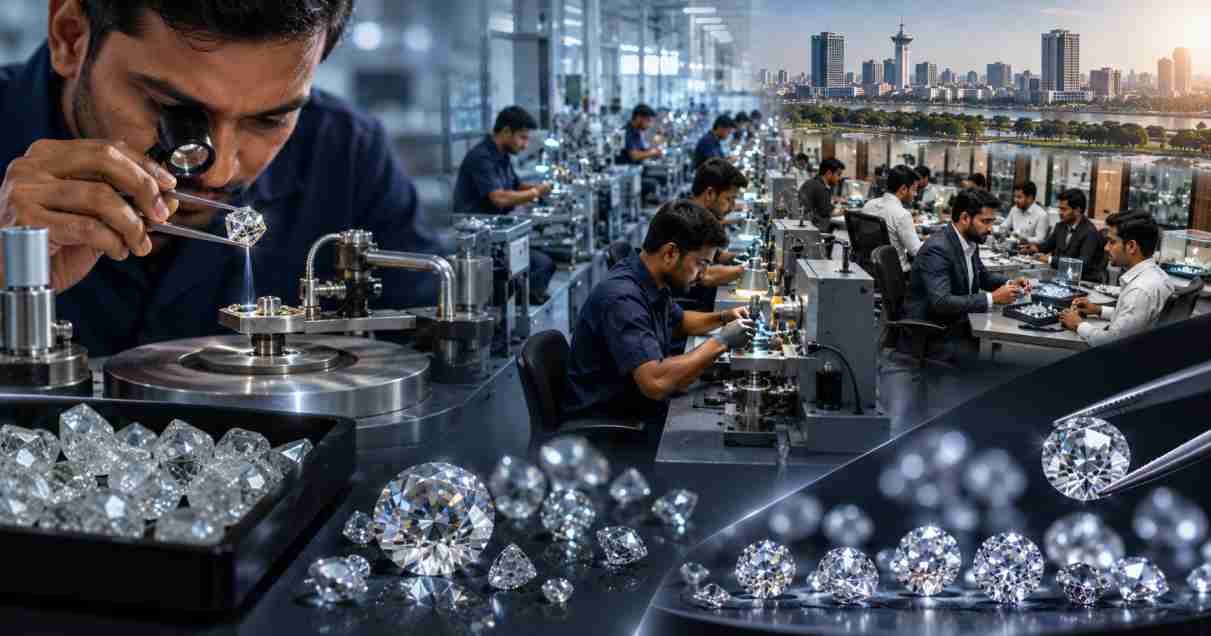
Then the most important stage begins - faceting and polishing. Using a rotating cast iron wheel called a scaife coated with diamond powder and oil, the cutter creates each facet of the diamond with extraordinary precision. A standard round brilliant diamond has 58 facets. Each one must be positioned and angled perfectly to maximise light reflection.
Finally, the polished diamond undergoes quality inspection and grading before being sorted, certified, and prepared for export.
Surat's Skilled Workforce - The Real Secret Behind Its Success
Machines and technology are important. However, the real secret behind Surat's diamond dominance is its people. Surat's diamond workers - known locally as kaarigars - are arguably the most skilled diamond craftspeople in the world.
Many Surat diamond workers come from families where the craft has been practised for two or three generations. Skills are passed down from father to son, from master to apprentice. This accumulated generational expertise creates a depth of craftsmanship that is extremely difficult for any other city or country to replicate at scale.
Also, Surat's diamond worker community is extraordinarily productive. The city's workforce processes stones of all sizes - including very small diamonds that require exceptional precision and patience - making Surat the only city in the world with the capacity and skill to handle the full range of global diamond production.
Surat vs Antwerp vs New York - How Surat Became Number One
The global diamond industry has several important cities, each playing a distinct role. Understanding how Surat compares to these cities helps clarify why it holds the title of Diamond Capital of the World.
Why Antwerp Lost Its Dominance
Antwerp remains a significant diamond trading and distribution hub, particularly for larger, higher-value stones. However, its role as a cutting and polishing centre has diminished significantly over the past three decades.
The primary reason is economics. Labour costs in Belgium are among the highest in the world. Training new diamond cutters is expensive and time-consuming. Also, Belgium's diamond workforce has aged, and fewer young people are entering the craft. These factors made it increasingly difficult for Antwerp to compete with Surat on volume and cost.
What Makes Surat Unbeatable in Diamond Processing
Surat's competitive advantages are deep and structural - not easily replicated. The city has an enormous, skilled, and experienced workforce. It has a highly efficient diamond processing infrastructure built over six decades. It has a strong community of diamond merchants, traders, and supporting businesses all concentrated in a single geographic area.
Also, Surat benefits from India's strong diamond trade ecosystem - including supportive government export policies, established banking and finance relationships for diamond trading, and world-class logistics infrastructure.
Together, these factors make Surat's position as the world's diamond processing capital effectively unassailable for the foreseeable future.
The Diamond Units of Surat - Inside the World's Largest Diamond Hub
Where Are Surat's Diamond Factories Located?
Surat's diamond industry is concentrated in several distinct areas of the city. Varachha is one of the most well-known diamond processing neighbourhoods, home to thousands of cutting and polishing units of all sizes - from small family workshops to large industrial factories.
Katargam is another major diamond district, known for its concentration of diamond trading offices and mid-size processing units. The Surat Diamond Bourse (SDB) - inaugurated in 2023 - is the world's largest office building and serves as the central hub for Surat's diamond trading community, bringing together thousands of diamond businesses under one roof.
Technology and Innovation in Surat's Diamond Units
Modern Surat is not just about traditional craftsmanship. The city's diamond industry has embraced technology at every level. Laser cutting machines allow for faster and more precise rough stone division. Computer-aided planning software analyses rough stones in three dimensions to optimise cutting decisions and maximise yield.
Automated polishing machines assist skilled workers in achieving consistent facet angles. Spectroscopic analysis equipment helps identify treated or synthetic diamonds during quality inspection.
Also, many larger Surat diamond companies have invested in artificial intelligence-based planning tools that can evaluate rough stone potential in seconds - work that once required hours of expert assessment.
Surat's Diamond Industry and the Indian Economy
How Much Does Surat Contribute to India's Diamond Exports?
India's gems and jewellery exports consistently rank among the country's top export categories. Diamonds alone account for a significant share of this total. Surat's diamond processing industry directly drives India's position as one of the world's leading diamond exporters.
The value of India's polished diamond exports runs into tens of billions of US dollars annually. The primary export destinations include the United States, Hong Kong, Belgium, the UAE, Japan, and Israel. Behind virtually every export shipment is the skill and infrastructure of Surat's diamond industry.
Employment and Livelihoods Powered by Diamonds
The diamond industry is one of the single largest sources of employment in Surat and the surrounding region of Gujarat. Estimates suggest that the industry directly employs between 800,000 and 1 million workers in cutting, polishing, sorting, and quality checking roles.
Beyond direct employment, the industry supports a vast ecosystem of indirect employment - in logistics, banking, food and catering, housing, retail, and professional services. Entire communities in Surat have been built on the prosperity generated by the diamond industry over the past six decades.
Lab-Grown Diamonds - Surat's Next Big Chapter
Why Surat is Leading the Lab - Grown Diamond Revolution
In recent years, lab-grown diamonds have emerged as one of the most significant new categories in the global diamond market. Lab-grown diamonds are chemically, optically, and physically identical to natural diamonds - the only difference is that they are created in a laboratory rather than mined from the earth.
Surat has moved quickly and decisively into lab-grown diamond production. The city is already home to a large and growing number of lab-grown diamond manufacturers, making it a world leader in this new category just as it has been in natural diamond processing.
India as a whole - and Surat in particular - now accounts for a significant and growing share of global lab-grown diamond production, benefiting from the same skilled workforce, manufacturing expertise, and trade infrastructure that built its natural diamond dominance.
How Lab-Grown Diamonds Are Changing the Industry
Lab-grown diamonds offer a more affordable and - according to many consumers - a more ethically straightforward alternative to mined diamonds. The global consumer appetite for lab-grown diamonds has grown dramatically, particularly among younger buyers in the USA, Europe, and India.
For Surat, this shift represents an opportunity rather than a threat. The city's manufacturers have adapted their facilities, retrained their workforces, and invested in new production technology to serve this growing market segment effectively.
Therefore, Surat's role as the diamond capital of the world is not tied to any single category of diamond. It evolves with the industry - and continues to lead.
Surat - The Diamond Capital of India and Its Global Reach
Key Diamond Export Markets from Surat
Surat's polished diamonds reach virtually every corner of the globe. The United States is consistently the largest market, absorbing a significant share of India's polished diamond exports annually. Hong Kong and Belgium serve as major re-export hubs, redistributing Indian diamonds to retailers and manufacturers worldwide.
The UAE - particularly Dubai - is a rapidly growing market for both polished diamonds and finished jewellery. Japan, Israel, and increasingly Southeast Asian markets also represent significant demand centres for Surat's diamond production.
Major Diamond Trade Associations Based in Surat
Surat is home to several important industry organisations that support, regulate, and promote the diamond trade. The Surat Diamond Association (SDA) represents the interests of diamond manufacturers and traders in the city. The GJEPC (Gems and Jewellery Export Promotion Council) has an active presence in Surat and works to promote Indian diamond exports globally.
The Surat Diamond Bourse, inaugurated in 2023, brings together thousands of diamond trading offices in a single world-class facility designed to position Surat as a complete global diamond trading centre - not just a processing hub.
Why Studying Diamonds and Gemology in Surat Gives You an Unmatched Advantage
Real Industry Exposure No Other City Can Offer
For students who want to build a career in diamonds, gemology, or the jewellery industry, studying in Surat offers an advantage that no other city in India - or in the world - can match.
When you study in Surat, the diamond industry is not something you read about in a textbook. It is happening all around you. The city's cutting factories, trading offices, grading laboratories, and export companies are part of the everyday landscape.
Students at institutes in Surat benefit from regular industry visits to diamond factories, guest lectures by active diamond traders and manufacturers, internship opportunities with real companies, and the chance to build professional networks that will serve them throughout their careers.
This live industry immersion is transformative. It turns theoretical knowledge into practical understanding in ways that classroom learning alone simply cannot achieve.
ISGJ - Learning Diamonds at the Heart of the Diamond Capital
ISGJ - International School of Gems and Jewellery is headquartered in Surat, right at the heart of the world's diamond capital. For over 25 years, ISGJ has been preparing students for successful careers in the gems and jewellery industry by combining rigorous academic education with real-world industry exposure.
ISGJ's programs in diamond grading, gemology, jewellery design, and gems and jewellery business management are taught by expert faculty with active industry experience. Students train in professional laboratories using real diamonds and gemological instruments.
Also, ISGJ's location in Surat means that industry visits, factory tours, and interactions with working diamond professionals are built into the educational experience - not occasional extras.
For anyone serious about a career in diamonds, there is no better place to learn than Surat - and no better institute in Surat than ISGJ.
Frequently Asked Questions About Surat as the Diamond Capital
Which city is known as the Diamond Capital of the World?
Surat, located in Gujarat, India, is universally recognised as the Diamond Capital of the World. The city processes over 90 percent of the world's diamonds by volume, making it the undisputed centre of global diamond cutting and polishing.
Why is Surat called the diamond capital of India?
Surat is called the diamond capital of India because it is home to over 5,000 diamond cutting and polishing units and employs close to one million skilled diamond workers. The city drives India's position as the world's largest polished diamond exporter.
How did Surat become the world diamond capital?
Surat's rise began in the 1960s when Gujarati merchants established cutting and polishing units in the city. Over six decades, Surat built a massive skilled workforce, efficient manufacturing infrastructure, and strong trade networks that made it the dominant global centre for diamond processing.
What percentage of world diamonds are cut in Surat?
Over 90 percent of the world's diamonds by volume are cut and polished in Surat. In value terms, India accounts for approximately 75 to 80 percent of global polished diamond exports, with Surat being the primary driver.
Is Surat involved in lab-grown diamonds as well?
Yes. Surat is rapidly becoming a global leader in lab-grown diamond production as well. Many of the city's manufacturers have expanded into this growing segment, maintaining Surat's position at the forefront of the global diamond industry.
What is the Surat Diamond Bourse?
The Surat Diamond Bourse (SDB), inaugurated in 2023, is the world's largest office building. It serves as a centralised hub for Surat's diamond trading community, bringing thousands of diamond businesses together in a single world-class commercial facility.
Be Part of the Diamond Capital's Story - Start at ISGJ
Surat's rise to become the Diamond Capital of the World is one of the great industrial success stories of modern India. It is a story of skill, community, enterprise, and continuous innovation. And it is a story that is still being written - with lab-grown diamonds, new technologies, and new markets opening new chapters every year.
If you want to be part of this extraordinary industry, the best place to start is right here - in Surat, at ISGJ.
Whether you are drawn to diamond grading, gemology, jewellery design, or gems and jewellery business management, ISGJ offers the programs, the faculty, the facilities, and the industry connections to help you build the career you aspire to.
The Diamond Capital of the World is waiting for your talent. Begin your journey today.